






















Blog - TECHNICAL TIPS & TRICKS - Solid State Relays - SSRs vs EMR: Who really costs less?


Relays are widely used in industrial and electronic systems to switch electrical loads on and off. Two main relay technologies are commonly used today: Electromechanical Relays (EMR) and Solid State Relays (SSR).
At first glance, electromechanical relays often seem more attractive because they are cheaper. However, solid state relays offer important advantages that can make them a smarter choice in many applications. This article explains the key differences in simple terms and looks at the real cost over time, not just the purchase price.
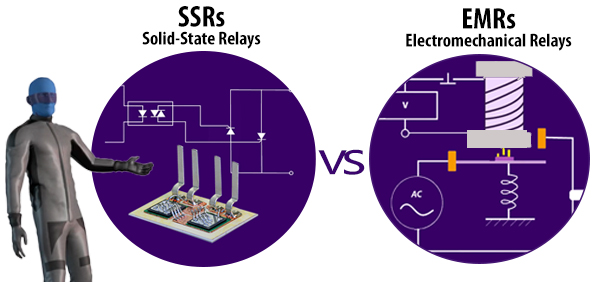
Electromechanical relays use moving parts. When activated, a small electromagnetic coil moves metal contacts to open or close a circuit. This movement produces a clicking sound.
Because EMRs rely on physical contact, the parts gradually wear out. Over time, the relay must be replaced, especially if it switches frequently.
Solid state relays perform the same switching function, but without moving parts. They use electronic components to turn loads on and off, silently and very quickly.
With no mechanical wear, SSRs are more durable and better suited for modern, high-performance systems.
SSRs switch much faster than EMRs and operate completely silently. They are also more resistant to vibration, shock, and harsh environments.
EMRs are slower and noisier, and their performance can degrade over time due to mechanical wear. While they work well for simple tasks, they are less reliable in demanding applications.
Because EMRs contain moving parts, they have a limited lifetime and need regular replacement. This means higher maintenance effort and potential downtime.
SSRs, on the other hand, can operate for many years without maintenance. When properly installed, they provide long-term reliability and reduce the risk of unexpected failures.
From a purchase price perspective, yes—SSRs usually cost more than EMRs. However, this is only part of the story.
When you consider:
SSRs often result in a lower total cost over the life of the system.
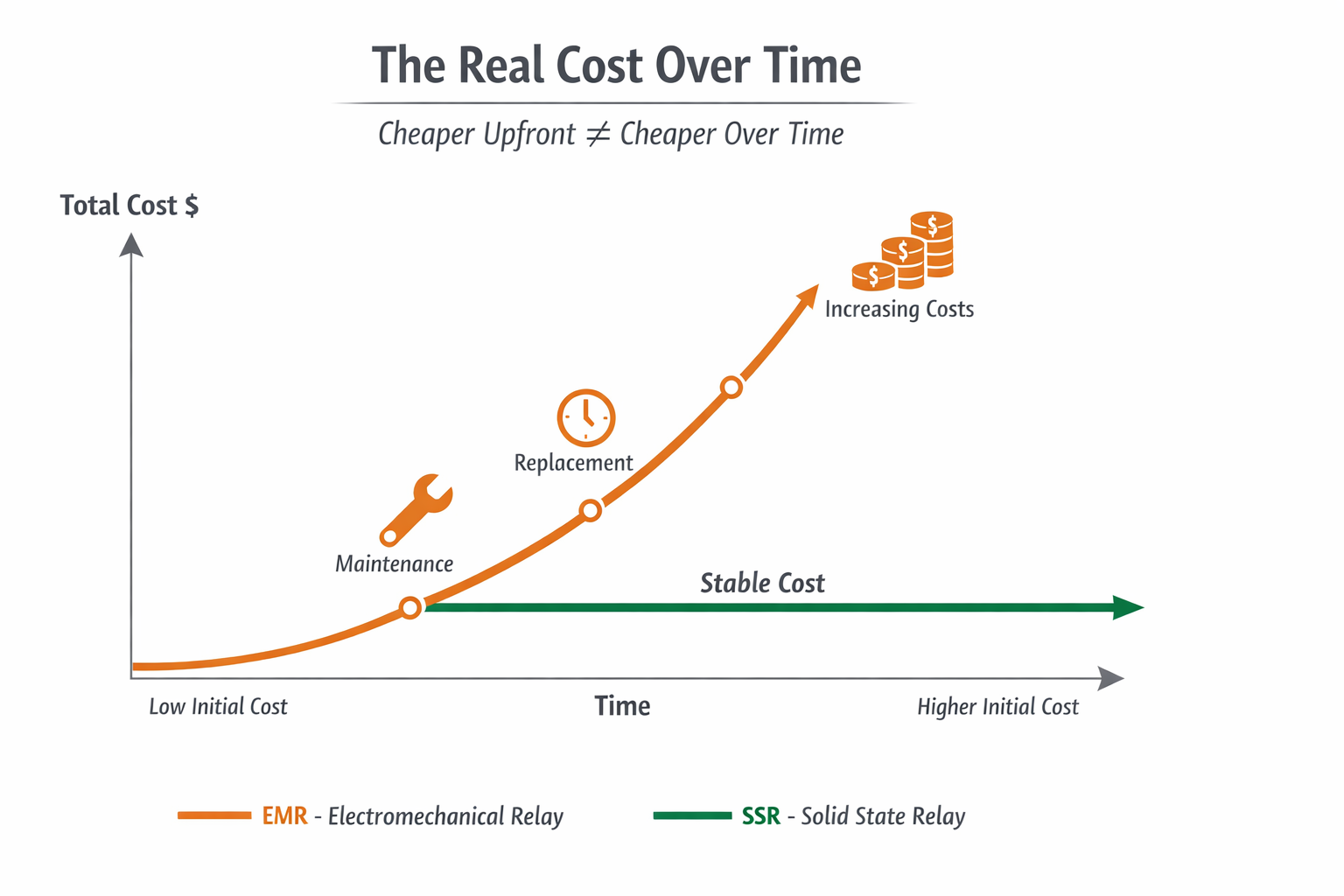
From a purely upfront perspective, EMRs are significantly less expensive than SSRs. This makes EMRs attractive for low-cost, low-duty-cycle applications. SSRs generally have a higher unit price due to their semiconductor components and packaging.
SSRs often require additional thermal management, such as heat sinks, which can increase initial system costs. EMRs typically do not require such considerations, making installation simpler and cheaper in many cases.
EMRs require periodic replacement due to contact wear, especially in applications with frequent switching or high currents. This results in ongoing maintenance costs and potential system downtime.
SSRs, by contrast, require little to no maintenance, significantly reducing long-term operational costs.
Because of their voltage drop, SSRs dissipate more power during operation, leading to higher energy consumption and heat generation. EMRs are more energy-efficient in the on-state. However, when switching frequency is high, EMRs may consume more energy overall due to repeated coil activation.
Relay failure can lead to production stoppages or system outages. Since EMRs fail more frequently, the indirect costs associated with downtime, troubleshooting, and replacement can exceed their low purchase price. SSRs, with their higher reliability, help minimize these hidden costs.
At first glance, SSRs appear more expensive due to their higher initial cost. However, when considering total cost of ownership, SSRs can be more economical in applications requiring frequent switching, high reliability, or minimal maintenance.
Conclusion
While electromechanical relays may appear more economical at first, Solid State Relays often provide greater value over time. Their reliability, long lifetime, and low maintenance make them an excellent choice for modern industrial and electronic applications.
The best relay is not necessarily the cheapest one—but the one that delivers the best performance and cost efficiency over its entire lifetime.

D‑U‑N‑S® Number : 382274546
Sales department France :
+33 (0) 4 77 53 90 20
Export sales department :
+33 (0) 4 77 53 90 21
———————————-
Gender Equality Index 2026
Based on 2025 data
Final result: 88/100 (for more information)

