





























Blog - EXPERTISES & INNOVATIONS - Relais statiques - Zero-cross or random relay : what are the differences ?
Both zero-cross and random solid state relays are used for industrial applications. What are the differences between these two types of switching?
In this new article, we give you tips to help you select the switching type best suited to your application in order to optimize reliability, electrical performance, and the service life of the SSR.
The choice of the switching type of a solid-state relay is often underestimated and treated as a simple secondary parameter. In reality, it directly determines the electrical behavior of the load, the stresses experienced by the SSR, and the level of disturbances generated on the power network.
A poor switching choice can lead to excessive inrush currents, additional thermal stresses, unstable load operation, or even electromagnetic compatibility issues.
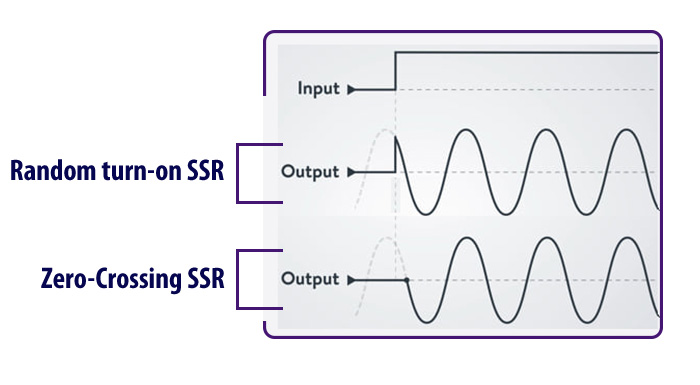
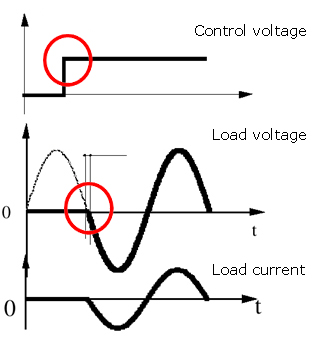
In the case of a ZERO VOLTAGE CONTROL (OR ZERO-CROSS RELAY), power switching takes place only at the beginning of the alternation after the control has been applied. In fact, switching the power component is only permitted in the area around the zero crossing.
This switching mode significantly reduces inrush currents and electromagnetic disturbances. It is particularly suitable for resistive loads such as heating elements, industrial ovens, or heating plates.
In the case of resistive or capacitive loads, it is preferable to use zero-cross relays which in this way limit the di/dt, disturbances on the network and increase the lifetime of the load and the relay.
However, zero-crossing switching introduces a slight turn-on delay, depending on the mains phase. This behavior is incompatible with certain applications requiring precise synchronization or fine power control.
Instantaneous-switching SSRs trigger immediately upon command, regardless of the phase of the mains voltage.
This type of switching is essential for inductive or highly capacitive loads, such as transformers, single-phase motors, solenoid valves, or switch-mode power supplies. It allows precise control of the switching moment and avoids certain erratic behaviors observed with zero-crossing switching.
On the other hand, instantaneous switching generates higher inrush currents and more electrical disturbances. It therefore requires more conservative SSR sizing and appropriately adapted associated protections.
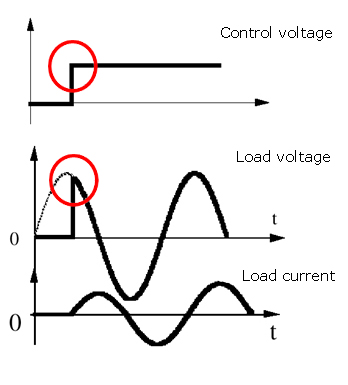
The switching type directly influences:
For example, using a zero-crossing SSR on a capacitive load can cause very high inrush currents at zero crossing, whereas a properly controlled instantaneous switching will be more reliable.
Conversely, using an instantaneous SSR on a simple heating resistor generates unnecessary stress and increases electromagnetic emissions without any functional benefit.
In power control applications (heating, thermal control), the switching type determines the control strategy.
Zero-crossing switching is particularly well suited to burst firing control, where several complete cycles are applied or cut off. This method limits network disturbances and improves SSR lifetime.
Instantaneous switching, on the other hand, is required for phase-angle control, which allows fine and fast power control but imposes higher electrical stresses and requires special attention to EMC.
The choice of the switching type should never be automatic. It must result from a combined analysis of the load, the control strategy, and network constraints.
In general:
• favor zero crossing for simple resistive loads
• use instantaneous switching for inductive, capacitive, or synchronized loads
• oversize and provide additional protection for instantaneous SSRs
celduc relais offers both zero-cross and random solid state relays.
SO8, SA8, SMT8, …. : Zero-Cross SSRs for all loads / heavy duty loads
SO9, SA9, SMT9, … : Zero-Cross SSRs for standard industrial loads / Resistive Loads aC-51
SO7, SA7, SGT7, … : Random SSRs
The switching type of an SSR is a key parameter in machine design. When properly chosen, it improves reliability, reduces electrical stress, and simplifies EMC compliance.
Integrated from the design phase, it avoids many field issues and sustainably secures the electrical architecture.

D‑U‑N‑S® Number : 382274546
Sales department France :
+33 (0) 4 77 53 90 20
Export sales department :
+33 (0) 4 77 53 90 21
———————————-
Gender Equality Index 2026
Based on 2025 data
Final result: 88/100 (for more information)

