




























Blog - EXPERTISE & INNOVATIONS - Solid State Relays - Heating loads
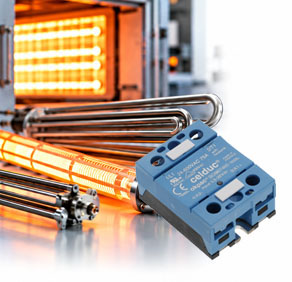 How to choose the right control mode for your Solid State Relay?
Industrial furnaces, ovens, thermoforming machines, cooking equipment, extrusion and injection moulding machines, drying systems… Temperature control is at the heart of many industrial processes.
However, achieving precise and stable temperatures does not depend solely on the power of the heating element. Choosing the right control mode is just as critical. It affects temperature control accuracy, power management, electrical disturbances and overall system reliability.
Thanks to their fast switching capability and absence of moving mechanical parts, Solid State Relays (SSRs) are particularly well suited to these applications. The key is to select the switching technology and control mode that best match the load.
Not all heating loads behave in the same way electrically.
A conventional resistive heating element generally exhibits relatively stable behaviour during operation. It is one of the most common applications for a solid state relay.
Other heating elements, however, have a significantly lower resistance when cold than under normal operating conditions. When switched on, they can therefore generate a high inrush current. This characteristic must be taken into account when selecting and sizing the SSR. This is particularly the case with certain lamps, infrared loads and specific heating technologies.
A heating load is therefore not necessarily a simple resistive load. Understanding its behaviour when cold, when hot and during transient phases is the first step towards reliable control.
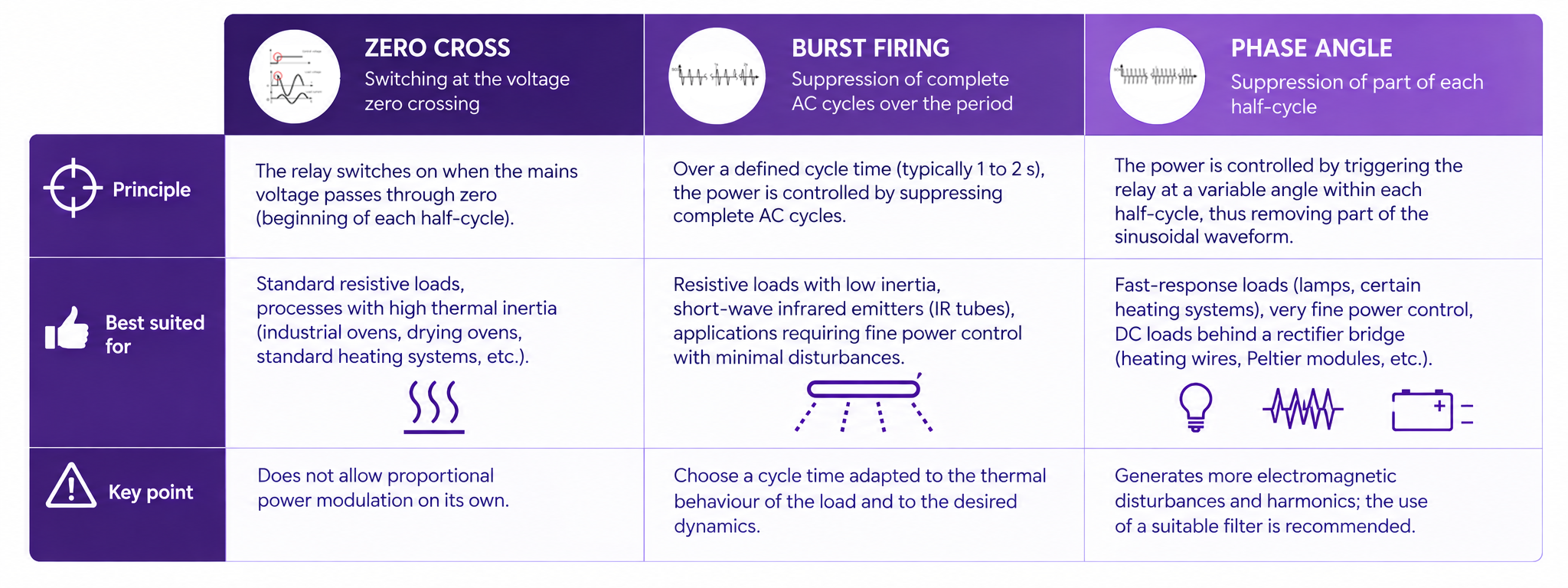
In a synchronous, or Zero Cross, solid state relay, conduction starts when the AC voltage is close to zero.
This switching method limits electrical transients and electromagnetic interference. It provides a simple and robust solution for most conventional resistive loads.
celduc® Zero Cross solid state relays are therefore particularly suitable for controlling heating systems with sufficient thermal inertia that do not require instantaneous power modulation.
Zero Cross switching is widely used in industrial furnaces, ovens, cooking equipment, plastics processing machinery and many other industrial heating applications.
For some heating applications, simple ON/OFF control is not sufficient. The celduc® burst controller modulates the average power delivered to the load according to the analogue control signal received.
Over a given cycle time, for example 1 or 2 seconds, power variation is achieved by suppressing complete AC cycles. Unlike conventional burst control, these suppressed cycles are not grouped together: they are distributed throughout the cycle according to a specific control pattern.
For example, with a control signal corresponding to 50% power, the controller can suppress every other cycle. This distribution provides more evenly delivered power over time while maintaining synchronous switching.
The main advantage of this technology is its ability to finely modulate power according to an analogue control signal while limiting electrical disturbances. It is particularly suitable for resistive loads with low thermal inertia, where rapid adjustment of the delivered power is required.
Typical applications include short-wave infrared emitters, such as infrared tubes, used in processes requiring a fast thermal response.
The celduc® SO3 range meets these requirements by combining proportional power control with complete-cycle switching.
For loads requiring a rapid response to power variations, Phase Angle control provides a particularly high level of control.
Its principle is similar to that of a light dimmer: instead of applying complete AC cycles to the load, the controller cuts part of each half-cycle of the mains voltage. The power delivered to the load is therefore modulated according to the control signal.
The relationship between the control input and power output depends on the controller model. It can be linear in phase angle, U² or Urms, allowing the control response to be adapted to the requirements of the process.
This modulation provides very precise power adjustment, which is particularly useful when accurate temperature regulation is essential or when the load responds rapidly to voltage variations.
Phase Angle control is therefore particularly suitable for low-inertia or fast-response loads, such as certain heating elements or lamps. It can also meet the requirements of certain DC loads supplied through a rectifier bridge, such as heating wires or Peltier modules.
However, this precision comes with a trade-off. Cutting each AC half-cycle generates more electromagnetic interference and harmonics than Zero Cross switching. The use of an appropriate filter is therefore recommended to limit these disturbances.
celduc® offers several Phase Angle controller solutions for single-phase and three-phase applications, including the SG4, SO4, SIL4/SIM4 and SGTA–SVTA ranges, enabling the control solution to be adapted to the installation architecture and load characteristics.
The choice depends primarily on the dynamics of the load and the level of control required. For a conventional resistive load with high thermal inertia, Zero Cross switching is generally sufficient. When the load responds rapidly, distributed burst control provides finer modulation while limiting electrical disturbances. Finally, Phase Angle control offers the most dynamic power control, but with greater EMC constraints.
Selecting a solid state relay based solely on the nominal current stated in its datasheet is a common mistake.
An SSR rated at 50A cannot necessarily switch 50A under all operating conditions.
The actual permissible current depends on ambient temperature, the cooling system, mounting conditions and the equipment’s operating environment.
When conducting, a solid state relay also generates losses due to the voltage drop across its power semiconductors. These losses must be dissipated efficiently to keep the junction temperature within the limits specified by the manufacturer.
Selecting the appropriate heatsink and installing it correctly are therefore integral parts of SSR sizing. View our tutorial video “How to install a Solid State Relay to get optimal performances”
Finally, the load’s nominal steady-state current is not always sufficient to select the SSR. Inrush currents must also be taken into account, particularly with heating elements whose resistance varies significantly with temperature.
The service life of a solid state relay depends as much on its design as on its operating conditions.
Load → SSR → Heatsink → Cabinet → Environment
An SSR that is correctly sized but installed on an inadequate heatsink or inside a cabinet where the temperature is too high will not operate under optimum conditions.
The quality of the thermal interface, compliance with tightening torques, electrical protection and airflow within the cabinet must therefore be considered from the design stage.
The relay’s internal design also plays a key role. Power semiconductor assembly, DCB technology and the management of thermomechanical stresses directly influence thermal performance and product lifetime.
At celduc®, these parameters are an integral part of the development and manufacturing of solid state relays, helping ensure reliable operation in demanding industrial applications.
For a conventional resistive heating element, a synchronous Zero Cross solid state relay is generally the preferred solution.
For precise temperature control in a furnace, oven or thermal process, combining a Zero Cross SSR with burst control enables effective adjustment of the average power delivered to the load.
When the application requires very rapid power variation or progressive management of the current during start-up, a proportional control solution may be more appropriate.
Finally, loads with a high cold-start current require particular attention. Their electrical behaviour should be analysed before selecting the control technology and SSR current rating.
With its various switching technologies and extensive range of single-phase and three-phase solid state relays and power control solutions, celduc® supports machine manufacturers in selecting the right solution for the load, the process and the actual operating conditions.
The right SSR starts with the right control mode
Optimising the control of a heating load is not simply a matter of selecting a relay capable of handling its nominal current.
Load type, start-up behaviour, control accuracy, response speed, electrical environment and thermal management must all be considered together.
Zero Cross, Burst Control or Phase Angle: choosing the appropriate technology provides the right balance between accuracy, power management, electromagnetic compatibility and reliability.

D‑U‑N‑S® Number : 382274546
Sales department France :
+33 (0) 4 77 53 90 20
Export sales department :
+33 (0) 4 77 53 90 21
———————————-
Gender Equality Index 2026
Based on 2025 data
Final result: 88/100 (for more information)

