

































Blog - EXPERTISE & INNOVATIONS - Magnetic Sensors - Magnetic sensors for improved performance
Reliable position detection is essential to machine performance. Magnetic sensors provide fast, accurate and contactless detection, helping reduce downtime, minimize maintenance and optimize production cycles. Discover how Reed and Hall effect sensors work, their advantages in demanding industrial environments, and the key criteria for choosing the right solution for your application.
An automated machine relies on very simple information: present or absent, open or closed, position reached or not. Yet these signals trigger operations, synchronize movements, determine cycle rates and ensure process safety. Inaccurate or faulty detection has immediate consequences: machine downtime, false triggering, reduced production rates and production defects.
Magnetic detection, reliable, fast and contactless, addresses these challenges : celduc® range of magnetic proximity sensors.
On a high-speed production line, every minute of downtime means fewer parts produced and tighter delivery deadlines. In this context, the sensor is no longer just an auxiliary component: it is a key link in the performance chain. This article explains how magnetic sensors work, their practical advantages and the criteria to consider when selecting the right solution for your machine.
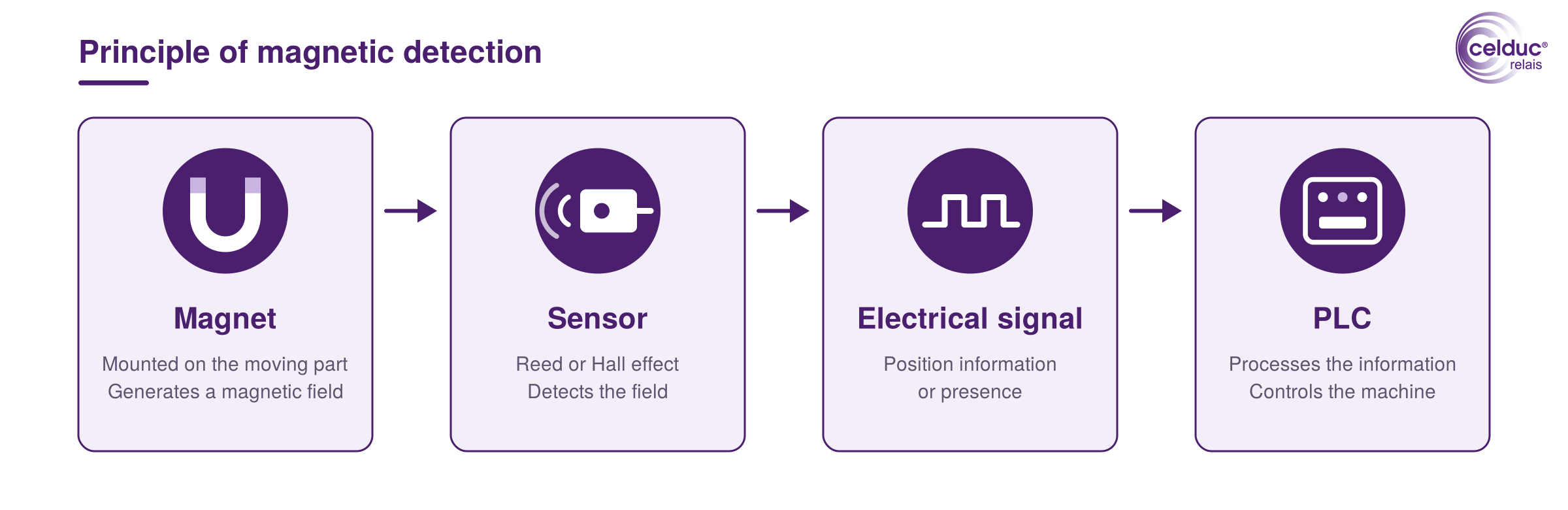
The principle is simple: a magnet attached to the moving part generates a magnetic field; the sensor detects it and converts it into an electrical signal that can be processed by the PLC.
Two technologies are commonly used: Reed sensors and Hall effect sensors. Both technologies operate on the same principle: a magnet attached to the moving part activates the sensor without contact. The Reed sensor, with its contact sealed inside a glass capsule, stands out for its simplicity, galvanic isolation and low power consumption: it is well suited to position detection in applications with moderate cycle rates. The Hall effect sensor, based on a semiconductor combined with electronic circuitry, has no moving parts and switches very quickly, with high repeatability. It therefore meets the requirements of high-speed applications and precision detection. The choice depends primarily on the application: cycle rate, expected accuracy and integration constraints.
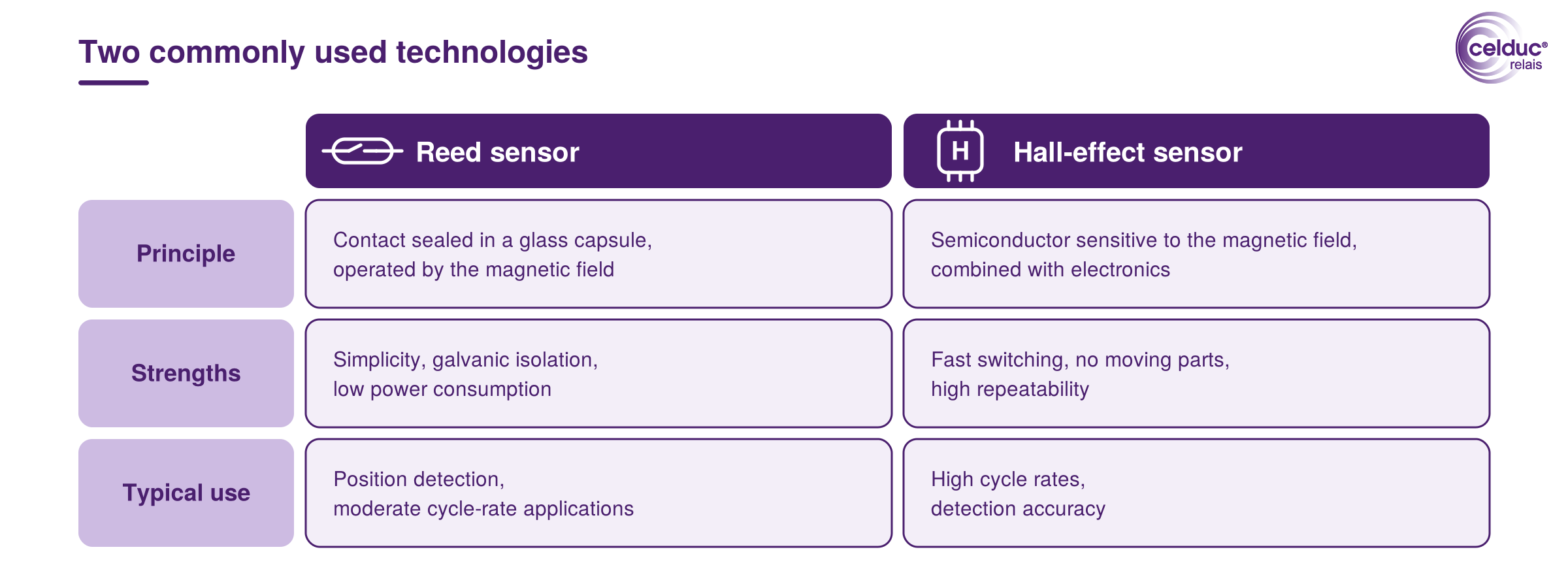
The choice depends on the application: sensing distance, switching frequency, expected accuracy, environment and required service life.
In both cases, the choice of magnet, its position and the presence of nearby ferromagnetic materials influence the actual sensing distance. It is therefore recommended to validate the magnet-sensor combination in the machine’s final configuration.
Watch our tutorial video about Magnetic Proximity sensors
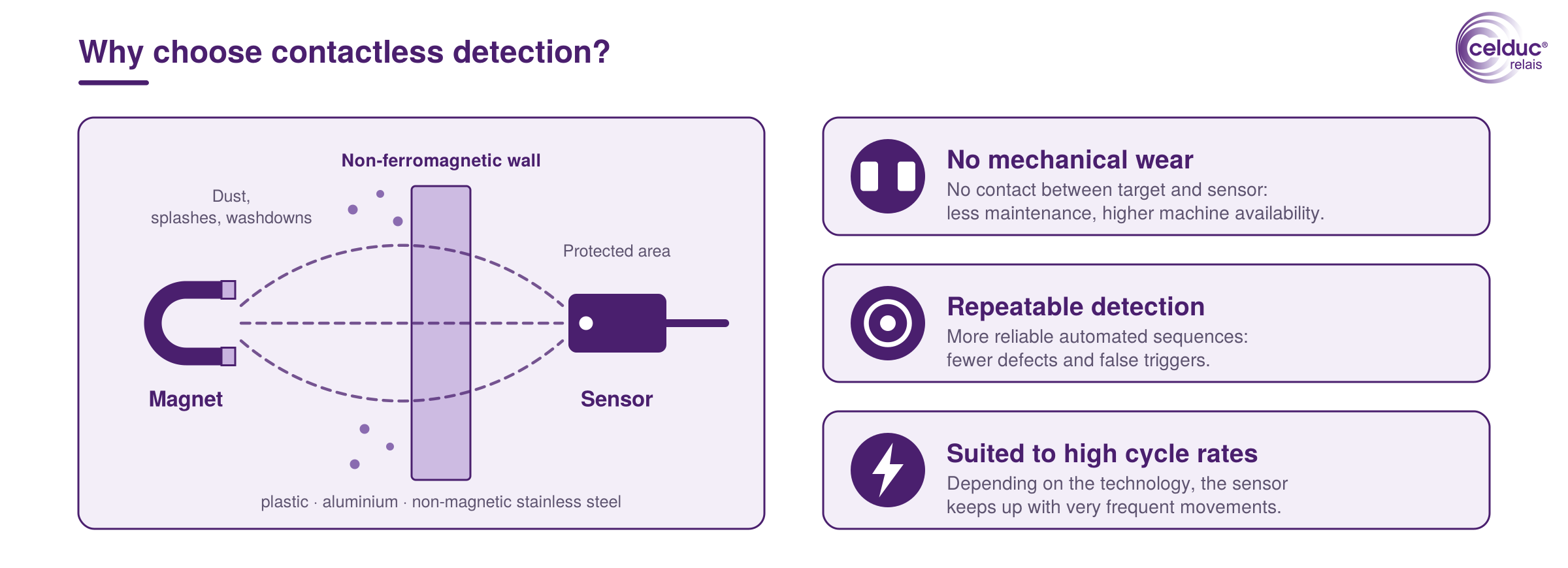
Another advantage: the magnetic field passes through non-ferromagnetic materials (plastic, aluminium, non-magnetic stainless steel). The sensor can therefore be positioned behind a wall, protected from splashes, dust or cleaning operations, which simplifies sealing of the assembly and protects the detection system.
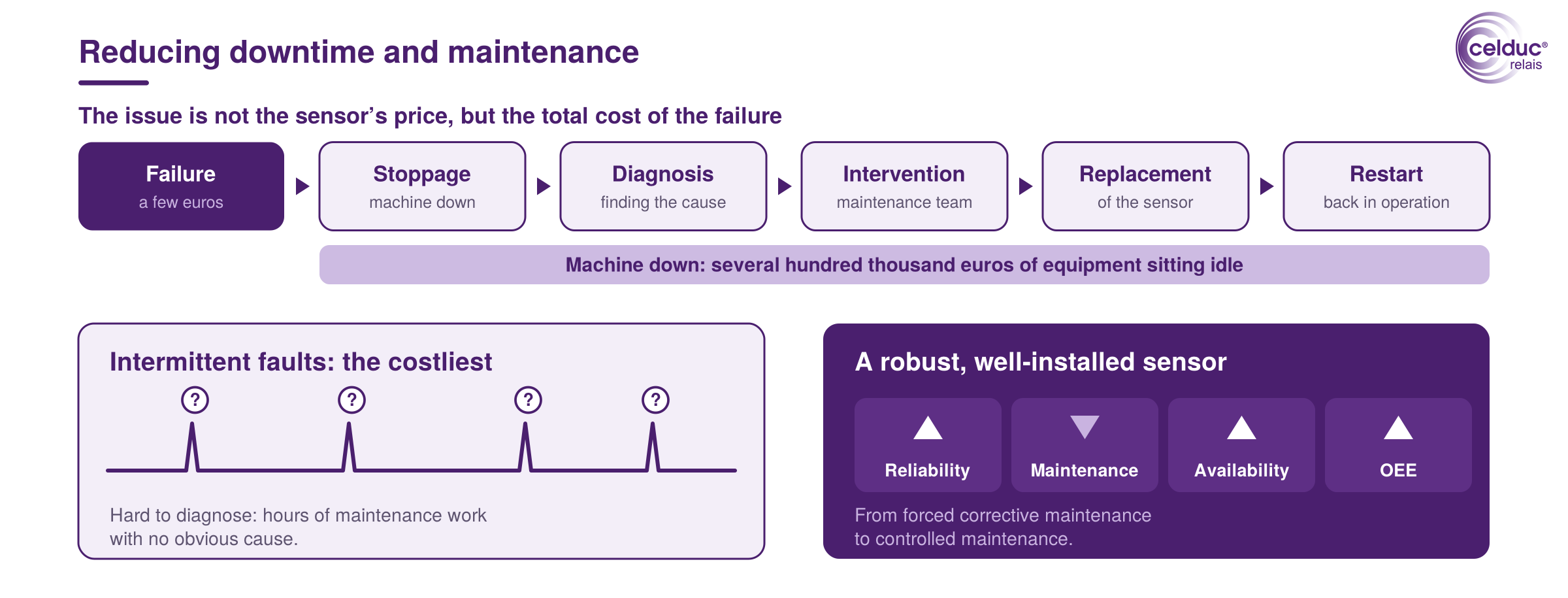
A sensor costing just a few euros can bring a machine worth several hundred thousand euros to a standstill. The issue is therefore not the price of the sensor, but the total cost of a failure: downtime, diagnosis, intervention, replacement and restart.
Intermittent faults are the most costly: difficult to diagnose, they can keep maintenance teams busy for hours without an obvious cause. A robust, correctly installed sensor limits these situations and makes it possible to move from reactive corrective maintenance to controlled maintenance.
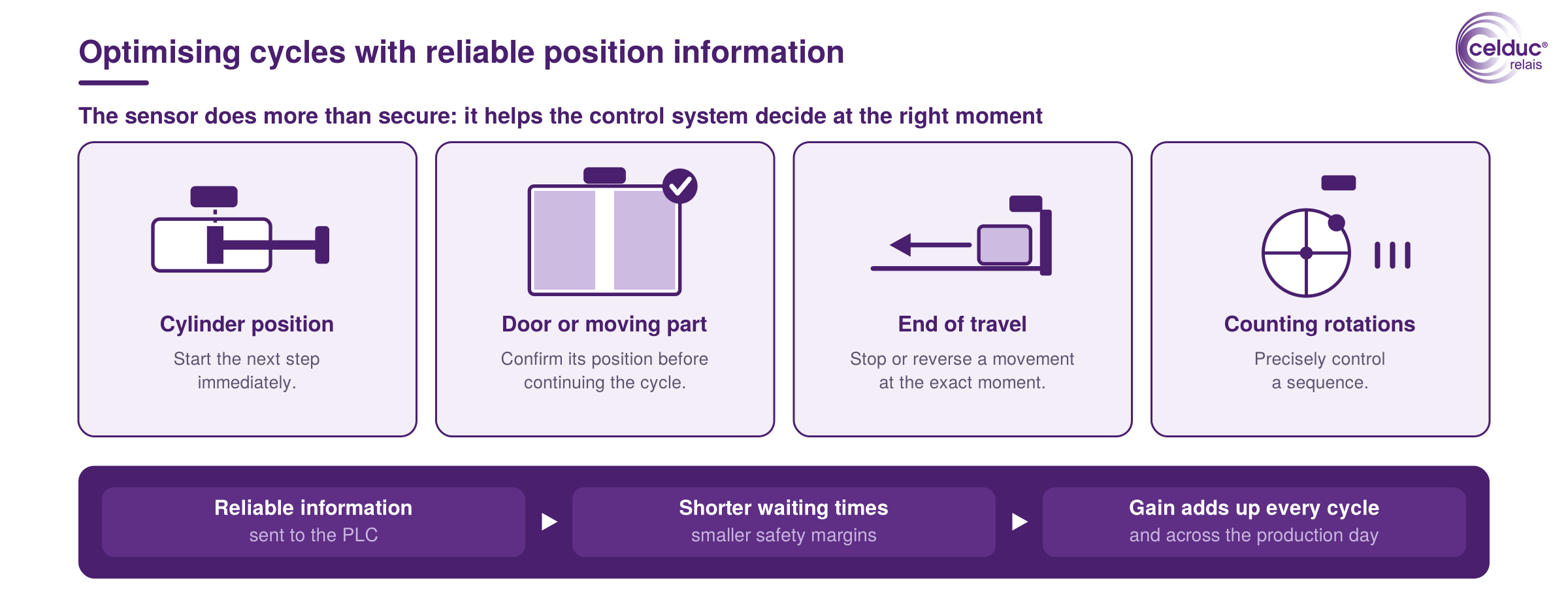
The sensor does more than ensure safety: it helps the automation system make decisions at the right time.
Every piece of reliable information transmitted to the PLC reduces waiting times between two steps and minimizes the safety margins usually added to compensate for uncertain detection. These gains accumulate with every cycle and therefore throughout the production day.
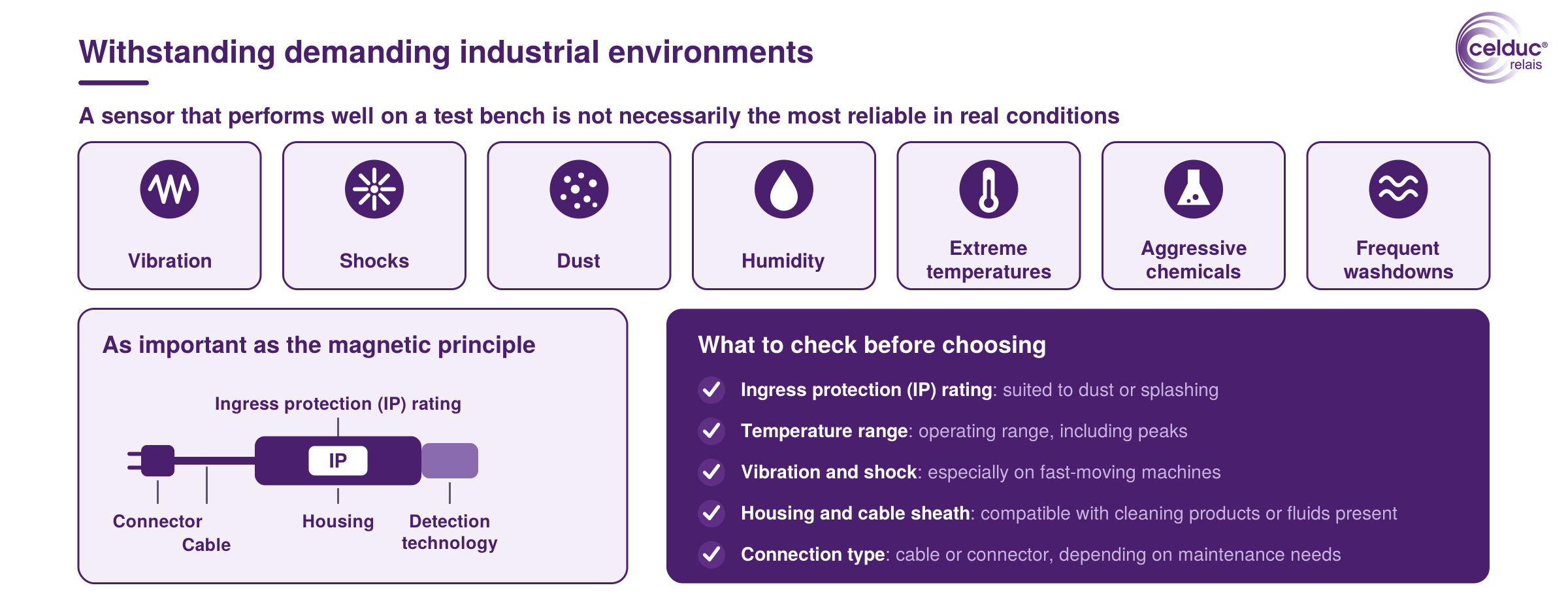
Vibrations, shocks, dust, humidity, extreme temperatures, aggressive substances, frequent washdowns: a sensor that performs well on a test bench is not necessarily the most reliable under real operating conditions. The housing, cable, connector, ingress protection rating (IP) and sensing technology are just as important as the magnetic principle itself.
Points to check before choosing:
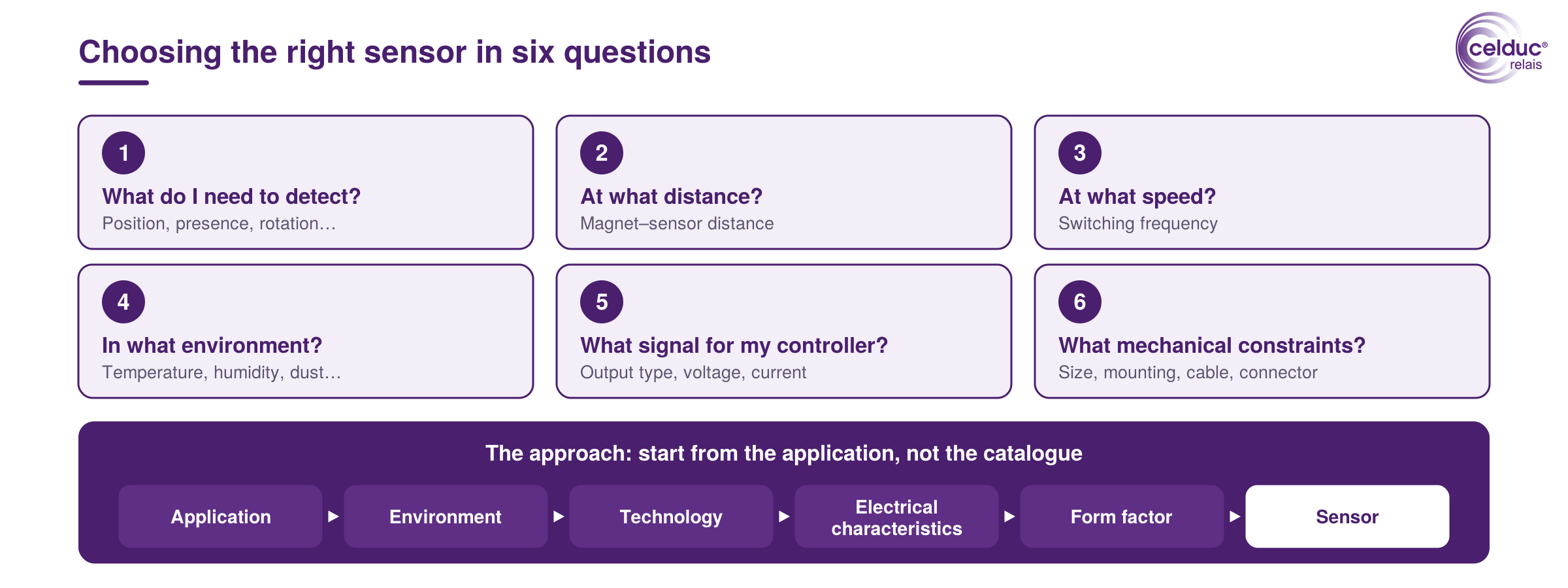
Choosing a magnetic sensor is not simply a matter of browsing a catalogue: it is better to start with the actual requirements and ask six simple questions, in order.
What do I need to detect? The first step is to define the required function: identify a position, confirm a presence, count rotations, monitor a level or detect an end-of-travel position. Each application has its own requirements, and this first answer guides everything that follows.
At what distance? Next, the gap between the magnet and the sensor must be determined. This sensing distance depends on the selected technology, but also on the magnet itself and its positioning on the machine.
At what speed? The required switching frequency determines whether the sensor must track moderate or very fast movements. This is a decisive criterion when choosing between technologies, as shown in the Reed / Hall comparison.
In what environment? Temperature, humidity, dust, vibrations, chemicals: actual operating conditions determine the choice of housing, cable and protection, far more than performance measured in a laboratory.
What signal does my control system require? The sensor must communicate with the control system. The output type, voltage and current must therefore be checked to ensure direct integration into the automation system.
What are the mechanical constraints? Finally, the available space, mounting method, choice between cable or connector and overall dimensions must be compatible with the machine, to facilitate both installation and maintenance.
These six answers define a logical approach: application, environment, technology, electrical characteristics, format, then sensor. Starting with the application rather than the catalogue avoids unpleasant surprises and costly over-specification.
Magnetic detection is not limited to a single field: it is used wherever the position or movement of an element needs to be determined reliably and without contact. From production lines to everyday equipment, requirements vary, but the objective remains the same: accurate information at the right time. Here are a few application examples.
In each of these situations, what matters is not the sensor alone but its integration into the machine: space constraints, operating conditions and availability requirements guide the choice.
It is not always necessary to adapt the machine to the sensor. Housing shape, cable length, connections, sensitivity, electrical characteristics, mounting method: at celduc® relais, the sensor can be designed to integrate into your application.
A well-designed adaptation simplifies installation, reduces the number of additional components and improves installation reliability. It begins with a discussion about the specifications: application, environment, volumes and integration constraints. The earlier this discussion takes place in the machine design process, the more naturally the sensor can be integrated.
Reliable detection, transmission of the right information, control at the right time: this is how magnetic detection improves the availability and cycle rates of your machines.
Have a detection project? Contact the celduc® relais teams to select or design the right sensor for your machine.

D‑U‑N‑S® Number : 382274546
Sales department France :
+33 (0) 4 77 53 90 20
Export sales department :
+33 (0) 4 77 53 90 21
———————————-
Gender Equality Index 2026
Based on 2025 data
Final result: 88/100 (for more information)

